

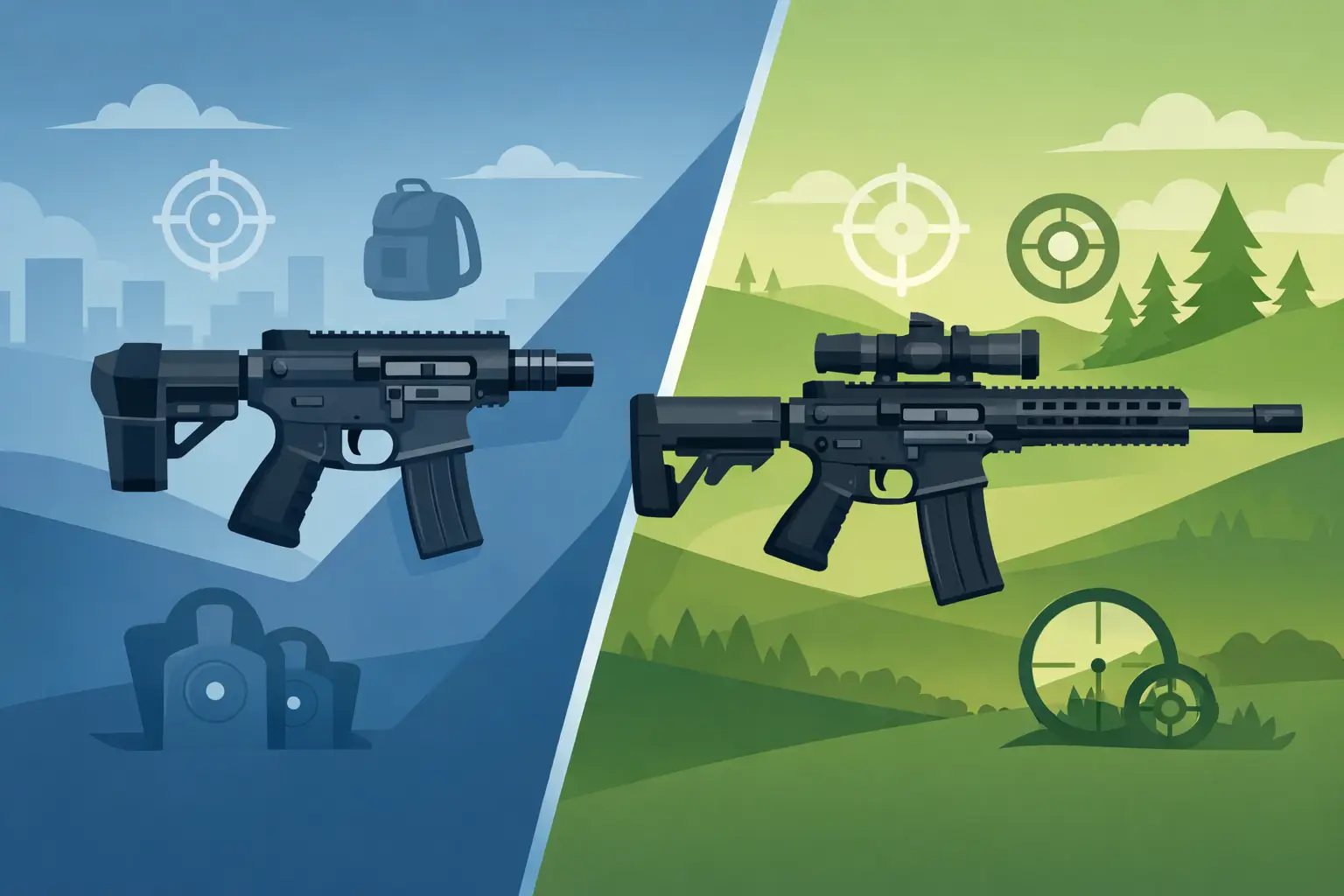
When buyers start comparing ar pistol vs rifle options, they usually are not asking for a history lesson. They want to know which one fits the job, what they gain, what they give up, and where the money makes the most sense. That is the right way to look at it, because the gap between the two is not just barrel length or looks. It affects handling, performance, storage, accessories, and how the gun fits your actual use.
AR pistol vs rifle at a glance
The fastest way to separate the two is this: an AR pistol is built and classified as a pistol, while an AR rifle is built and classified as a rifle. That sounds obvious, but it drives nearly every practical difference that matters to the buyer.
An AR pistol is generally more compact, easier to maneuver in tight spaces, and attractive to shooters who want a shorter overall package. An AR rifle gives you the traditional shoulder-stock setup, more velocity in most calibers, and a more forgiving shooting experience for general-purpose use. If you are shopping for one gun to cover the most ground, the rifle usually has the broader comfort zone. If compactness is high on your list, the pistol starts looking strong very quickly.
Size and handling are where the choice starts
Most buyers notice the same thing right away. AR pistols feel handier in vehicles, around barriers, and on compact ranges. A shorter barrel and shorter overall footprint make them quicker to move and easier to store. For home-defense-minded buyers, that compact format is often the main selling point.
The trade-off is that shorter guns can feel busier under recoil and blast, especially indoors or on a crowded firing line. You are getting a compact package, but usually with more concussion and less forgiveness. That does not make the platform bad. It just means the benefits come with a cost.
AR rifles are easier for many shooters to settle behind, especially if they are newer to the platform or planning longer range sessions. The added length helps stability. The full stock setup is familiar, comfortable, and easier to fit to different body types and shooting positions. If you are buying for range time, training, and broad utility, that extra control matters.
Barrel length changes performance more than buyers expect
This is where the rifle begins to pull ahead in raw ballistic performance. In common calibers like 5.56 NATO, longer barrels generally produce higher velocity. More velocity can mean better fragmentation or expansion with the right load, flatter trajectory, and stronger downrange performance.
Short-barreled AR pistols give up some of that velocity. At close range, that may not be a dealbreaker depending on your intended use and ammunition choice. But if your plan includes stretching distance, hitting smaller targets, or getting the most from a cartridge designed around more barrel length, a rifle gives you a clearer advantage.
That is why many experienced buyers are honest about the mission. If the gun will mostly live at the range, ride as a truck gun where legal, or serve as a compact defensive option, an AR pistol can make plenty of sense. If it needs to do a little of everything, including more confident performance at distance, the rifle is often the safer bet.
AR pistol vs rifle for home defense
This is one of the biggest reasons shoppers compare the two. In close quarters, the AR pistol has obvious appeal. It is shorter, quicker to bring on target, and easier to work around hallways, corners, and furniture. For buyers who want a modern defensive firearm in a compact package, that is a real advantage.
But compact is not the same as easy in every respect. Short barrels can produce significant muzzle blast and flash, especially in 5.56. In a confined space, that matters. A rifle is longer, but it can be easier to control and more comfortable to shoot well under pressure.
A lot depends on the shooter. If you are experienced, train regularly, and prioritize maneuverability, the pistol may be the better fit. If you want the more stable, more forgiving setup for repeated practice and easier accuracy, the rifle still has a strong case.
Range use and training usually favor the rifle
For straightforward range work, the rifle wins for many shooters. It is more comfortable over long sessions, usually quieter to the shooter compared with a short pistol setup, and easier to keep consistent from drill to drill. If you are introducing a new shooter to the AR platform, a rifle is often the more approachable starting point.
The rifle also gives you more flexibility with traditional setups. Iron sights, LPVOs, magnified optics, bipods, and slings all fit naturally into the role. Yes, an AR pistol can be accessorized heavily too, but once you start loading it up, the compact advantage starts shrinking.
Buyers who want a practical all-around gun often end up with a rifle because it simply asks for fewer compromises. It is not the flashier choice. It is the one that stays useful across the widest range of situations.
Legal and configuration issues are not a side note
This part matters because a bad assumption can turn a simple purchase into a major problem. AR pistols and AR rifles are not interchangeable from a legal standpoint just because they look similar. The classification depends on how the firearm is built and configured.
That means buyers need to pay attention to barrel length, overall configuration, stocks versus braces where applicable, and current federal, state, and local rules. Regulations can shift, and state restrictions can be far more aggressive than federal baseline rules. Smart buyers verify before they buy, before they modify, and before they travel.
The bottom line is simple. Shop carefully, read the specs carefully, and make sure the firearm you order matches both your intended use and your local legal environment. A trusted online seller with clear product listings and current inventory makes that process easier, which is exactly why serious buyers pay attention to where they shop.
Cost is not just the sticker price
A lot of buyers assume the cheaper tag wins. That is rarely the full story. The purchase price is only one part of what you will spend.
An AR pistol may lead to extra spending on muzzle devices, upgraded optics, compact weapon lights, slings, or specialized storage solutions. A rifle may ask for less tuning to feel comfortable out of the box, especially for general-purpose shooting. Ammunition choice matters too, because some shooters end up experimenting more to find loads that perform well from shorter barrels.
There is also the value question. If a rifle gives you better comfort, easier hits, and wider utility, paying a little more can be the smarter buy. If a pistol gives you the exact footprint you need and you know why you want it, that premium can be justified just as easily.
Which buyer should choose an AR pistol
The AR pistol makes sense for a buyer who wants a compact firearm first and is willing to accept the trade-offs that come with that size. It fits well for shooters focused on maneuverability, storage in tighter spaces where legal, and a shorter overall package for defensive or recreational use.
It also appeals to experienced enthusiasts who already own a standard rifle and want something different for a specific role. If you know the mission and want a compact setup built around that mission, the pistol can be a strong addition.
Where buyers get into trouble is expecting it to do everything better. It will not. It does some things extremely well, but it is still a compromise-driven format.
Which buyer should choose an AR rifle
The AR rifle is the better choice for the buyer who wants one platform that covers the most ground. It is easier for training, more comfortable for longer sessions, generally stronger in ballistic performance, and simpler for many shooters to run effectively.
If you are buying your first AR-pattern firearm, a rifle is often the more straightforward purchase. You get the traditional setup, fewer practical drawbacks, and broader usefulness across defense, recreation, and general-purpose ownership.
For many customers, the rifle is not just the safer choice. It is the better value because it delivers performance without asking the shooter to work around the limitations of a shorter system.
The real answer to AR pistol vs rifle
There is no serious answer without context. If compact handling is your top priority and you understand the legal and performance trade-offs, the AR pistol can be the right buy. If you want maximum versatility, better long-range confidence, and an easier shooting experience, the rifle remains hard to beat.
The smartest buyers do not chase what is trendy. They buy the platform that fits the job, the space, and the way they actually shoot. If you stay honest about that, the right choice usually becomes obvious long before checkout.